onselectstart="return false;"  oncontextmenu="window.event.returnValue=false;" 

2015年11月6日 星期五

西概Note week8

Hera

The wife and one of three sisters of Zeus in the Olympian pantheon of Greek mythology and religion. Her chief function was as the goddess of women and marriage. Her counterpart in the religion of ancient Rome was Juno. The cow, lion and the peacock were considered sacred to her. 

Pygmalion : the creator fall in love with his / her work (play)

Pygmalion is a play by George Bernard Shaw, named after a Greek mythological character. In ancient Greek mythology, Pygmalion fell in love with one of his sculptures, which then came to life. The general idea of that myth was a popular subject for Victorian era English playwrights, including one of Shaw's influences, W. S. Gilbert, who wrote a successful play based on the story called Pygmalion and Galatea first presented in 1871. Shaw would also have been familiar with the burlesque version, Galatea, or Pygmalion Reversed. Shaw's play has been adapted numerous times, most notably as the musical My Fair Lady and the film of that name.
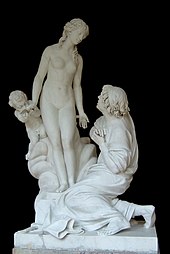

Galatea (mythology)

is a name popularly applied to the statue carved of ivory by Pygmalion of Cyprus, which then came to life, in Greek mythology; in modern English the name usually alludes to that story. Galatea is also the name of Polyphemus's object.


My fair lady


A misogynistic and snobbish phonetics professor agrees to a wager that he can take a flower girl and make her presentable in high society.


  • vanity fair (a magazine)


  • vanity vanity all is vanity 


  • Bicentennial Man (film)

Bicentennial Man is a 1999 American science fiction comedy-drama film.

Based on the novel The Positronic Man, co-written by Isaac Asimov and Robert Silverberg, which is itself based on Asimov's original novella titled The Bicentennial Man, the plot explores issues of humanity, slavery, prejudice, maturity, intellectual freedom, conformity, sex, love, and mortality.

Bi- :two
1.          Bicentennial man
2.          bicycle

延伸 :比馬龍效應


  • Pygmalion effect
A better future higher expectations, they will show the phenomenon. . Pygmalion is a self-fulfilling prophecy development. In this view, the heart often with negative expectations of the people will fail; but the heart often with positive expectations of the people will succeed. In sociology, this effect is often cited and education or social class related.


  • Paraphrase :

A restatement of the meaning of a text or passage using other words. The term itself is derived via Latin paraphrasis from Greek παράφρασις, meaning "additional manner of expression". The act of paraphrasing is also called "paraphrasis".A paraphrase typically explains or clarifies the text that is being paraphrased. A paraphrase does not need to accompany a direct quotation, the paraphrase typically serves to put the source's statement into perspective or to clarify the context in which it appeared. A paraphrase is typically more detailed than a summary. One should add the source at the end of the sentence, 

l   Duty → a legal or moral obligation
For example:He has a duty under the terms of his contract to pay rent.
1.          be someone’s duty to do something: It is your duty as a parent to protect your children.
2.          owe/have a duty to someone: The company has a duty to its shareholders.
3.          sense of duty: He has a strong sense of family duty.
4.          do your duty: I was simply doing my duty as a good citizen.
l   Responsibility →the state or job of being in charge of someone or something and of making sure that what they do or what happens to them is right or satisfactory
For example:She has a lot of responsibility as a nurse.
1.          responsibility for: Overall responsibility for the school lies with the head teacher.
2.          have responsibility for (doing) something: You will have responsibility for sales and marketing.
3.          take responsibility for (doing) something: Would someone take responsibility for bringing Paul home?
4.          assume responsibility for (doing) something: Serrano immediately assumed temporary responsibility for foreign affairs.
5.          a position of responsibility: People in positions of responsibility cannot behave like this.
l   Obligation → something that you must do for legal or moral reasons
1.          have an obligation to someone/something: The firm has an obligation to its customers.
2.          obligation to do something: Buyers have no legal obligation to disclose personal financial information.
3.          meet/honour/fulfil an obligation: The council has failed to fullfil its statutory obligation to the public.
4.          without (any) obligation: Estimates are available on request, without obligation.

ü  Obligations 債務
ü  Duty free :duty-free goods are cheaper than the usual price because you do not pay any tax on them.


  • Syllable
voc- ; vok :to call
1.          vocal → relating to the voice, or done with the voice
2.          invoke → to ask for help from someone who is stronger or more powerful, especially a god.
                     For example:Prayers invoking divine protection.


dic- :to say; to tell a word
1.          dictator → someone who tells people what to do and refuses to listen to their opinions 
2.          dictionary → to tell the words meaning


man- hand
  1. manipulation → influences someone or controls something in a clever or dishonest way
  2. manuscript → a writer’s original pages of a book, article, or document before it is published
  3. manual → a book containing instructions for doing something, especially for operating a machine
Pro- :many; much; in favor of
  1. propaganda → information, especially false information, that a government or organization spreads in order to influence people’s opinions and beliefs
  2. protagonist →  the main character in a play, film, book, or story


Patron → someone who supports the work of writers, artists, musicians etc, especially by giving them money(主寶神)
St. Christophen (the patron god of travel)
Patron saint

Patronage (n.) (v.) → help or money that is given to a person or organization

(主顧關係) (政治酬庸)


2015年11月5日 星期四

英文字彙與字源學Note week7

Ø   Syllable

       -cracy; -crat- govern
1.          Democracy (n.) = people + govern 民主政體
    →a system of government in which people vote in elections to choose the people who will govern them
2.          monocracy (n.) = one + govern 獨裁政治
3.          bureaucracy → a complicated and annoying system of rules and processes
 demo- people; show me something
1.      demo →music a piece of recorded music that a new singer or group sends to a recording company
2.      democracy
3.      demonstration → an event that proves a fact
                   →an occasion when a large group of people protest about something
        uni- one
1.         union → belonging to or connected with a union (單一;勞工關係下的工會)
※    We are on strike.
2.          uniform → a set of clothes that you wear to show that you are part of a particular organization or school
3.          unicorn → an imaginary creature like a horse with a single long horn on its head
4.          unique → very special, unusual, or good

      → not the same as anything or anyone else

      -clude – close; shut
1.          exclude → to deliberately prevent someone or something from being involved in an activity or from entering a place
ex: out
For example:  exclude someone from something: The committee now has to decide whether to exclude him from the competition.
2.          include→to make someone or something part of a group, set, or collection of things
in: in; inside
For example: include something in/on something: His work was recently included in an exhibition of young painters

Se- apart from
1.          seclude → to keep someone apart from other people
2.          separate → not together, or not joined to something else
For example: separate from: Clients’ funds should be kept separate from the firm’s own money

      alter- rotate; switch; change
alternative → something that you can choose instead of something else
For example: alternative current 

選擇 : option / choice

       -tive – a noun form
1.          representative → a politician who is a member of the US House of Representatives
2.          preservative → the process of working to protect something valuable so that it is not damaged or destroyed
For example: preservation of: an organization devoted to the preservation of historic buildings

      Serve- to keep; to save; to protect
1.          preserve → to take care of a place or building in order to prevent it from being harmed or destroyed.
       → keep something intact
2.          reserve → a supply of something that a country or an organization can use when they need to
3.          deserve → if you deserve something, it is right that you get it, for example because of the way you have behaved
For example: deserve to do something: I work hard, and I think I deserve to be well paid.
4.          conserve → to prevent land, water, or other natural resources from being damaged or destroyed

       re- again
1.          reiterate → to repeat something in order to emphasize it or make it very clear to people
2.          renaissance → new interest in something that makes it popular again
the Renaissance the period in Europe between the 14th and 16th centuries when there was increased interest in ancient Greece and Rome, which produced new developments in art, literature, science, architecture .

ten- to hold
tenacious → a tenacious person is very determined and is not willing to stop when they are trying to achieve something
         → tenacious ideas, beliefs, or habits continue for a long time and are difficult to change


-ly is adjective
cowardly 
lovely
deadly
friendly
deadly

Ø   The Wonderful Wizard of Oz
The Wonderful Wizard of Oz is an American children's novel.
The story is the adventures of a young farm girl named Dorothy in the magical Land of Oz, after she and her pet dog Toto are swept away from their Kansas home by a cyclone.
On her way, Dorothy frees the Scarecrow, and meets the Cowardly Lion. The Scarecrow wants a brain, the Tin Woodman wants a heart, and the Cowardly Lion wants courage. 
And start their journey.


Ø   Utopia (烏托邦)
A utopia is a community or society possessing highly desirable or near perfect qualities. The word was coined by Sir Thomas More in Greek for his 1516 book Utopia (in Latin), describing a fictional island society in the Atlantic Ocean. The term has been used to describe both intentional communities that attempt to create an ideal society, and imagined societies portrayed in fiction. It has spawned other concepts, most prominently dystopia.


Ø   西斯廷教堂 : our father who art in heaven


Ø   Pietà (Michelangelo)
The Pietà is a work of Renaissance sculpture by Michelangelo Buonarroti, housed in St. Peter's Basilica, Vatican City. It is the first of a number of works of the same theme by the artist. The theme is of Northern origin, popular by that time in France but not yet in Italy. Michelangelo's interpretation of the Pietà is unprecedented in Italian sculpture. It is an important work as it balances the Renaissance ideals of classical beauty with naturalism.


Ø   United States Declaration of Independence
The Declaration of Independence is the statement adopted by the Continental Congress meeting at Philadelphia, Pennsylvania on July 4, 1776, which announced that the thirteen American colonies,[2] then at war with Great Britain, regarded themselves as thirteen newly independent sovereign states, and no longer a part of the British Empire. Instead they formed a new nation—the United States of America. John Adams was a leader in pushing for independence, which was unanimously approved on July 2. A committee of five had already drafted the formal declaration, to be ready when Congress voted on independence. The term "Declaration of Independence" is not used in the document itself.


2015年11月4日 星期三

西概Note week7

l   Xenia
This article is about the ancient Greek concept of hospitality.
The generosity and courtesy shown to those who are far from home or associates of the person bestowing guest-friendship. The rituals of hospitality created and expressed a reciprocal relationship between guest and host expressed in both material benefits (such as the giving of gifts to each party) as well as non-material ones (such as protection, shelter, favors, or certain normative rights).

https://en.wikipedia.org/wiki/Xenia_(Greek)

Xerox  /ˈzɪərɒks/  copy: 複印
Carbon copy: (c.c) 副本(usually give to the person whose position is lower than you)


Q-tips;tulip – 鬱金香
tampon – 衛生棉條;Kotex (靠得住衛生棉)

l   Ally – 同盟國;軸心國
e.g. Athena is Odysseus’ greatest ally.


l   Hermes: the god of message
Hermes is a god of transitions and boundaries. He is quick and cunning, and moves freely between the worlds of the mortal and divine, as an emissary and messenger of the god

l   Iris: the goddess of message
 In Greek mythology, Iris is the personification of the rainbow and messenger of the gods. She is also known as one of the goddesses of the sea and the sky. Iris links the gods to humanity. She travels with the speed of wind from one end of the world to the other,[ and into the depths of the sea and the underworld.


  • lDactylic

A dactyl is a foot in poetic meter. In quantitative verse, often used in Greek or Latin, a dactyl is a long syllable followed by two short syllables, as determined by syllable weight. In accentual verse, often used in English, it is a stressed syllable followed by two unstressed syllables—the opposite is the anapaest (two unstressed followed by a stressed syllable).
A useful mnemonic for remembering this long-short-short pattern is to consider the relative lengths of the three bones of a human finger: beginning at the knuckle, it is one long bone followed by two shorter ones (hence the name dactyl).

An example of dactylic meter is the first line of Henry Wadsworth Longfellow's poem Evangeline, which is in dactylic hexameter:
This is the / forest prim- / eval. The / murmuring / pines and the / hem locks,
The first five feet of the line are dactyls; the sixth a trochee.

https://en.wikipedia.org/wiki/Dactyl_(poetry)

Vocabulary:
Mourn (v.) to feel extremely sad because someone has died and to express this in public.
*mourn for
Lament   (v.) to show publicly that you feel sad or disappointed about something
Elegy (n.) a poem or other piece of writing expressing sadness, usually about someone’s death
Ransom (n.) the amount of money that someone wants to be paid before they will let a person who they are keeping prisoner go free

                (v.) to pay an amount of money to someone in order to make them let someone they are keeping as a prisoner go free.